Recurring Systems.
Multiple editions produced from changing monthly inputs while maintaining a consistent information and visual system.
- Recurring production
- Multiple stakeholder inputs
- High-volume content selection
- Internal distribution

Content Strategy / Editorial System
I build editorial systems around what the audience needs to notice, understand and remember.
My process is to identify the strongest stories, establish hierarchy, compress complex information without stripping away context, and create a consistent structure that can adapt as the content changes.

01 / Two Editorial Systems
The Schneider Electric newsletters demonstrate the ability to sustain a recurring editorial system over time. The CynLr work explores how an editorial concept can be built from a blank strategic brief.
Schneider Electric
Multiple editions produced from changing monthly inputs while maintaining a consistent information and visual system.
CynLr
Four newsletter concepts developed as part of a content strategy problem statement, with greater emphasis on editorial voice, narrative and strategic framing.
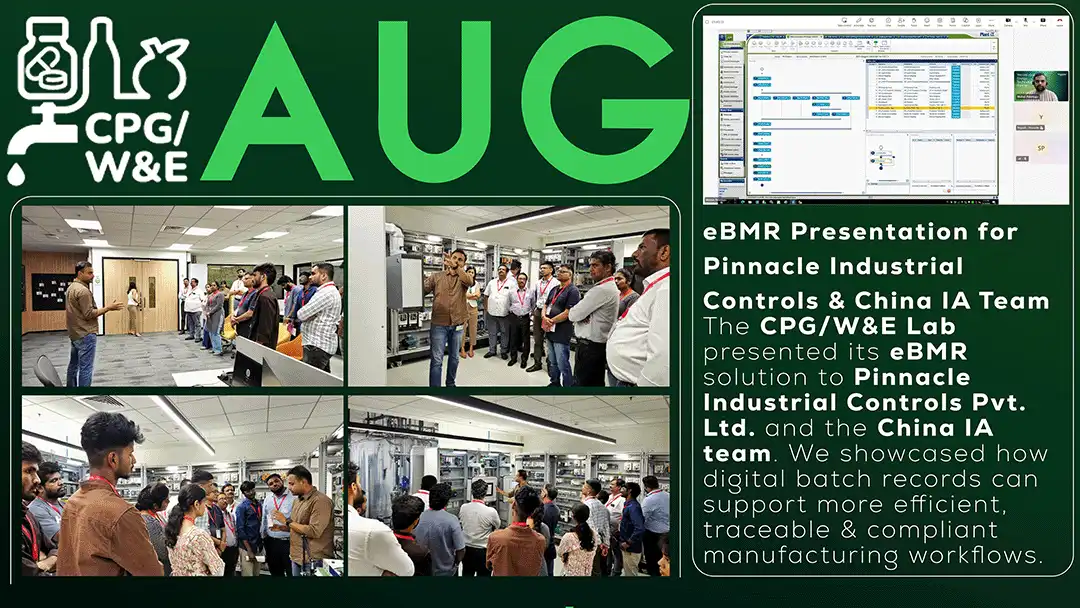
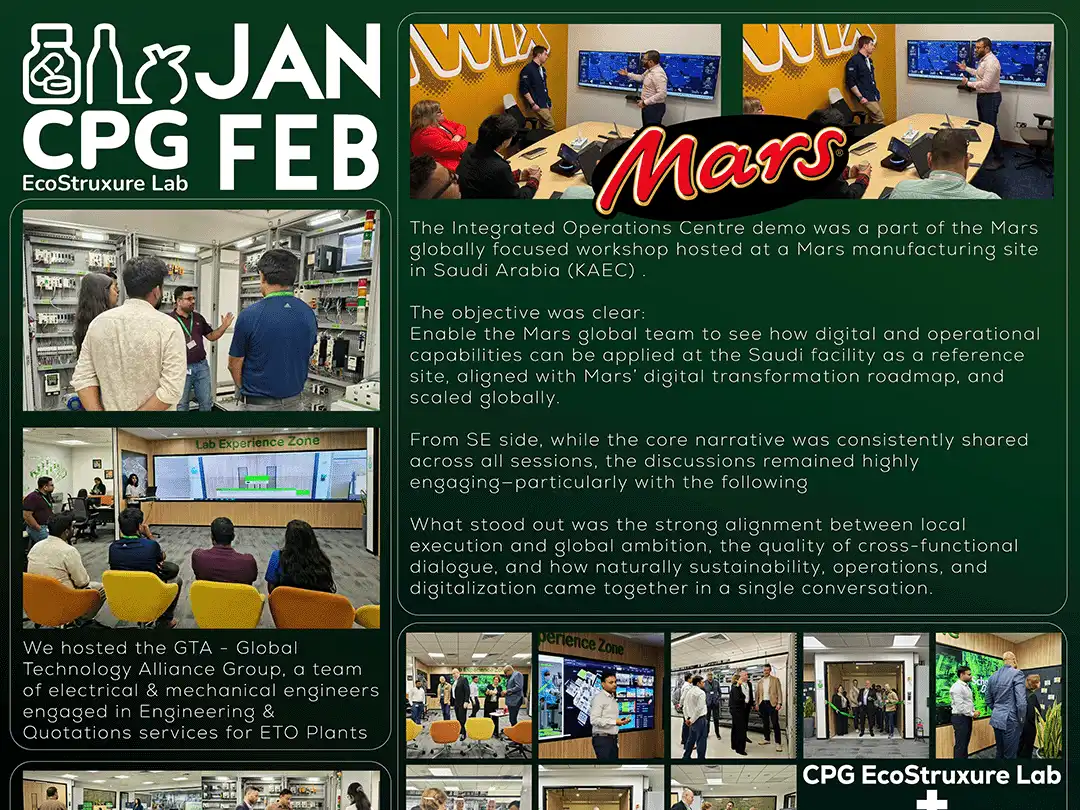
Schneider Electric
The system evolved from open, modular editorial compositions toward a denser and more structured visual language as the volume and complexity of lab communication increased.
Evolved editorial system
Earlier editorial system
Newsletter
Schneider Electric / Editorial Workflow
The format was recurring, but the content was not. Each edition required collecting, filtering and structuring a new set of inputs before the visual production stage began.
Gather monthly photos, activity updates and stakeholder inputs.
Identify which activities deserve visibility in the issue.
Balance visits, demos, presentations, events and announcements.
Condense technical and internal updates into short readable copy.
Adapt the recurring visual system to changing content volume.
Publish across internal communities and surface relevant stakeholders.
Schneider Electric / Content Architecture
Although the exact content changed every month, the newsletter repeatedly needed to balance several types of activity without allowing any single issue to become visually or editorially chaotic.
Schneider Electric / Issue Deconstruction
A finished newsletter is the visible output, but the underlying work is deciding what leads, what supports it and how much context each story needs.
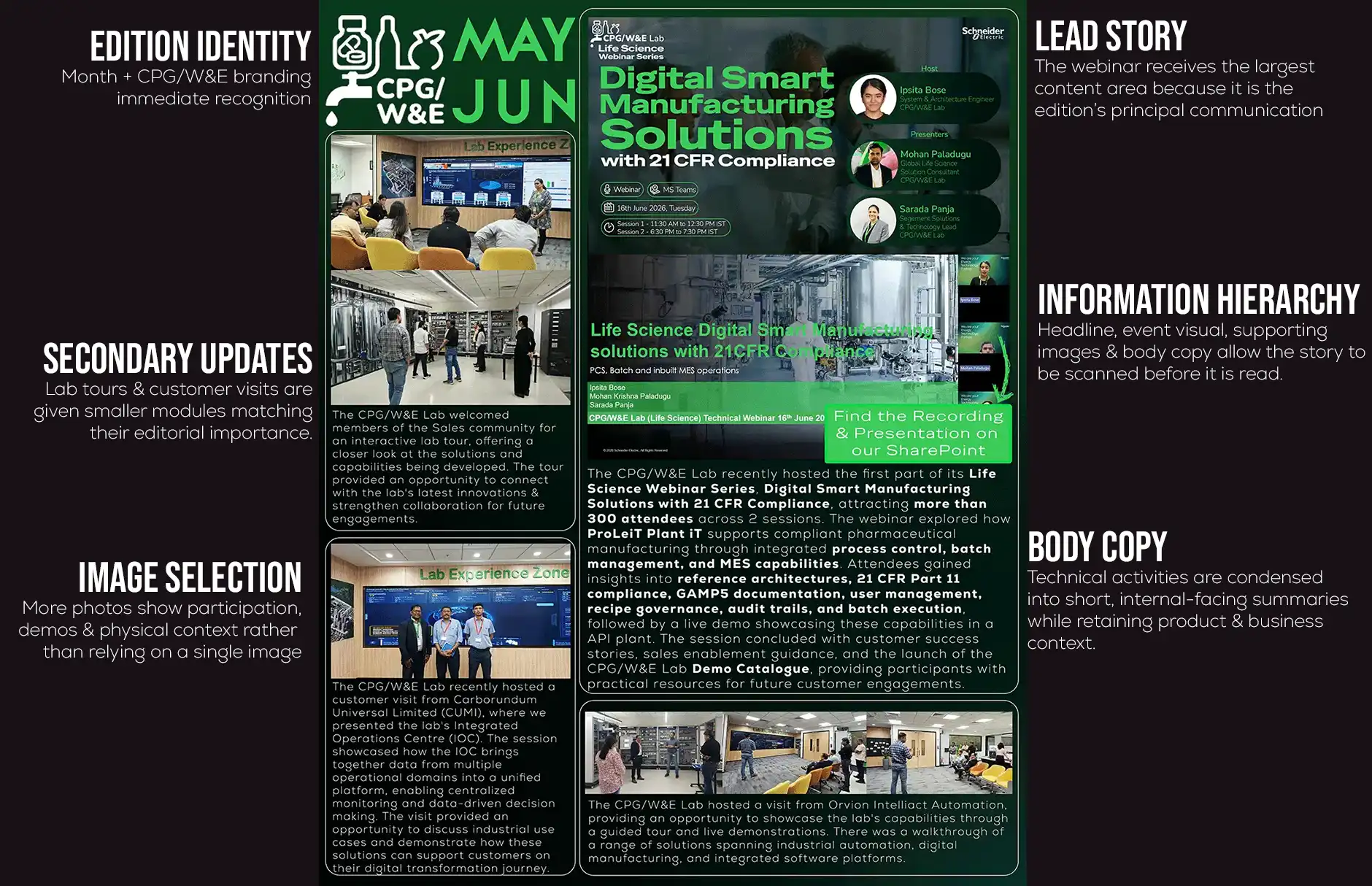
Highest visual prominence given to the update with the strongest relevance for the month.
Supporting activities grouped without competing with the primary story.
Photos used as evidence of activity while maintaining enough visual variety across the issue.
Technical and internal information compressed into short, scan-friendly communication.
Schneider Electric / Distribution
Each issue was distributed across multiple internal communities, with a mix of recurring and content-specific stakeholders tagged according to the activities featured in that month.
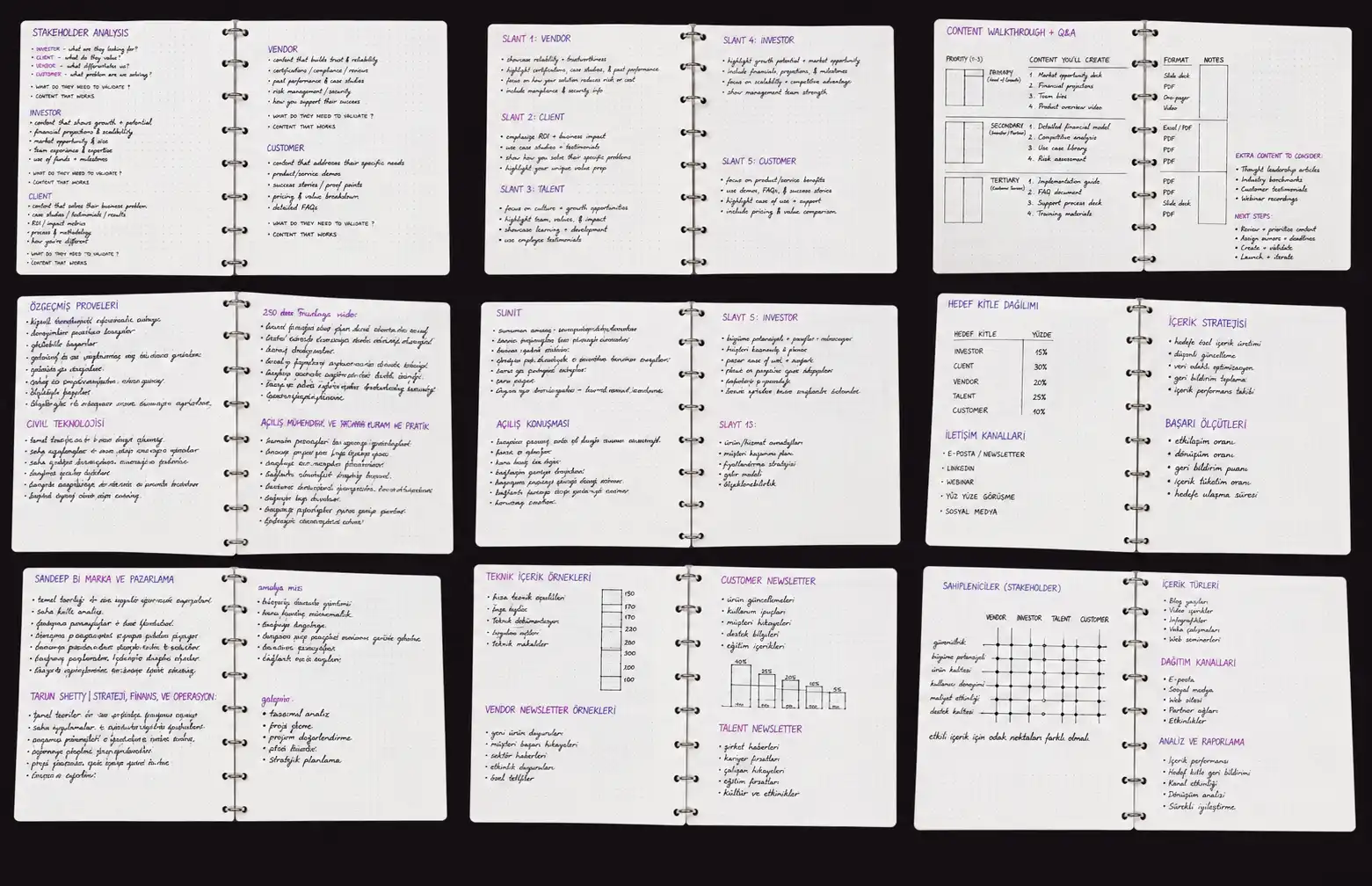
CynLr
I approached the CynLr newsletter problem as a perception-engineering exercise rather than a generic editorial task. The same pool of company stories was filtered through four stakeholder lenses — talent, investors, vendors and customers — based on what each audience needed to validate before engaging further.
The work therefore began with the stakeholder question, not the available story: Do I want to build here? Can this scale? Where do we fit? Can this solve my problem? Content selection, sequencing, visual emphasis and calls to action were then shaped around that question.
CynLr / Stakeholder Architecture
Each newsletter draws from the same underlying pool of company activity, but the editorial logic changes with the reader. Stories move up or down the hierarchy depending on whether they signal technical depth, commercial traction, ecosystem relevance or real-world manufacturing value.
The consistency comes from the decision framework, not from making every edition look or read the same.
Talent
Prioritises hard-technology work, product progress, research depth, global exposure and evidence that CynLr is a serious place to build a technical career.
Investor
Leads with capital confidence, expansion, technical defensibility and market pull — the signals that turn innovation into a credible growth story.
Vendor
Reframes CynLr as part of a wider robotics ecosystem, foregrounding platform relationships, integration potential and the points where partners can contribute.
Customer
Prioritises enterprise validation, manufacturing relevance and recognisable use cases so the reader can quickly connect CynLr's capabilities to their own operational context.
CynLr / Editorial Deep Dive
The deeper editorial task was not writing four versions of the same newsletter. It was deciding which stories mattered to each stakeholder, what those stories proved, how they should be ordered, and what action the reader should be encouraged to take next.
The same update could therefore become a lead story for one audience, supporting proof for another, or disappear entirely when it did not answer that stakeholder's question.
Source / Content Pool
Start with the full pool of company activity: product releases, customer visits, partnerships, research collaborations, funding, events and expansion.
Stakeholder Question
Define the perception gap first. The editorial angle follows from the question the reader is trying to answer.
Proof Hierarchy
Rank stories according to their value for that audience. Lead with the strongest proof signal, use secondary stories to reinforce credibility, and remove information that does not advance the argument.
Editorial Treatment
Adapt hierarchy, density, imagery, labels and calls to action to the reader: people-led for talent, metrics-led for investors, ecosystem-led for vendors and enterprise proof-led for customers.
CynLr / What This Work Demonstrates
BACK TO